
A year ago, extracting a 700-page PDF was a lot of manual work and could easily take a month.
Today it can be done in an hour.
That doesn’t mean digitization has become trivial – it means the bottleneck moved.
But let’s go back for a second – because the real topic here isn’t “PDF.” It’s the hidden value of what publishers already have.
Most publishers sit on a goldmine of layout-based content – often created and maintained in tools like InDesign. And that content can be used far beyond print: for digital products, new business models, and even for publisher-grade (and secure) AI experiences built on trusted source material.
For years, the problem was the cost of turning print-oriented layouts into something digitally reusable. If you wanted to use the content outside print, you often had to run a CMS in parallel, or switch to content-first – because every update meant doing expensive digitization work again.
That has changed.
Today, you can keep your existing print workflow, export a well-structured PDF from InDesign, and use it as a clean, consistent foundation for fast AI-assisted extraction. And because extraction is now fast and repeatable, you can run it as often as you need – without turning every revision into a cost explosion.
In short: Whenever you need your print-data digitally, run it through the extractor – quickly and cost-effectively.
PDFs aren’t built for reuse (and that’s the point)
PDFs are designed for humans. To be read, printed, and archived.
Not ideal for the digital world and for machines processing the content.
In layout-heavy documents, the layout itself carries meaning. A human instantly understands what’s a headline, what’s a sidebar, what’s a caption, what’s the main text, what’s an info box, and what’s an ad.
That’s why “getting the text out” is not the goal. Publishers don’t need a big text dump that someone has to clean up by hand. They need structured content: content with hierarchy and semantics that can flow into editorial systems, websites, apps, and learning experiences. And yes – content that is “AI-ready” in a practical sense for publishers, because it has structure you can trust.
Extraction today means structure (not just OCR)
OCR (Optical Character Recognition) is one solution – because it turns pixels into text. If you feed it a scanned page or an image-based PDF, OCR will identify letters and words, so the document becomes searchable and copyable.
But OCR doesn’t solve the whole problem publishers have to solve. OCR can tell you what characters appear on a page. It usually can’t tell you what those characters are in a publishing sense – or how they should behave downstream.
A magazine page is a perfect example: the biggest text might be a headline, but sometimes it’s a pull quote. A short paragraph might be a caption, or it might be a sidebar intro. A block in a colored box could be an “info box,” a glossary definition, a legal note, or an ad. OCR often extracts the text, but it doesn’t reliably preserve the structure, hierarchy, and intent behind it.
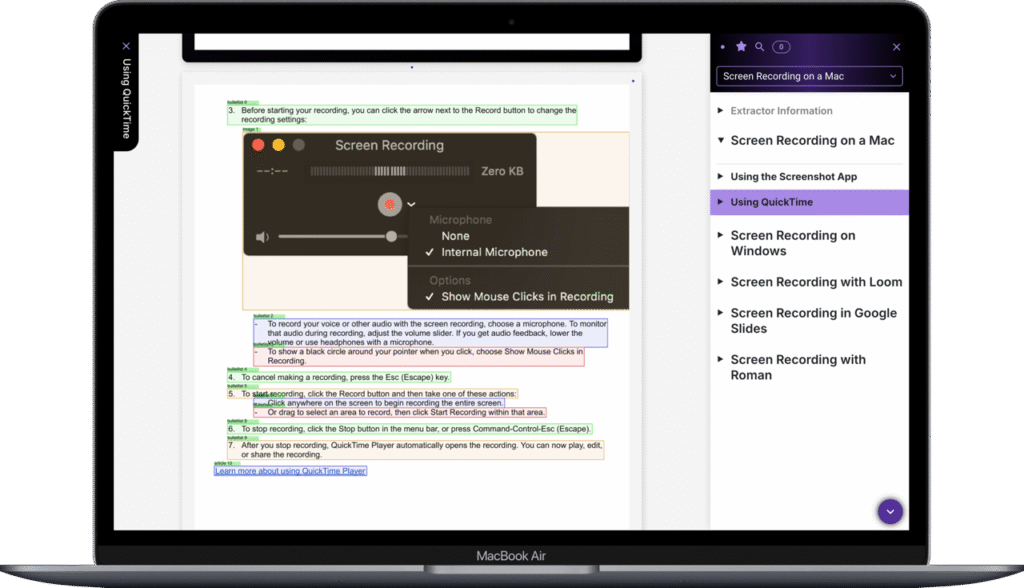
That’s why extraction in a production context has to answer a different question: “What is this piece of content?” A heading is not just a larger font. A caption is not just a short paragraph. A callout is not just a box with text. If you want reusable content, you have to preserve these distinctions – and you have to do it consistently across a whole publication, not just on a good day.
The pipeline: make it repeatable, not magical
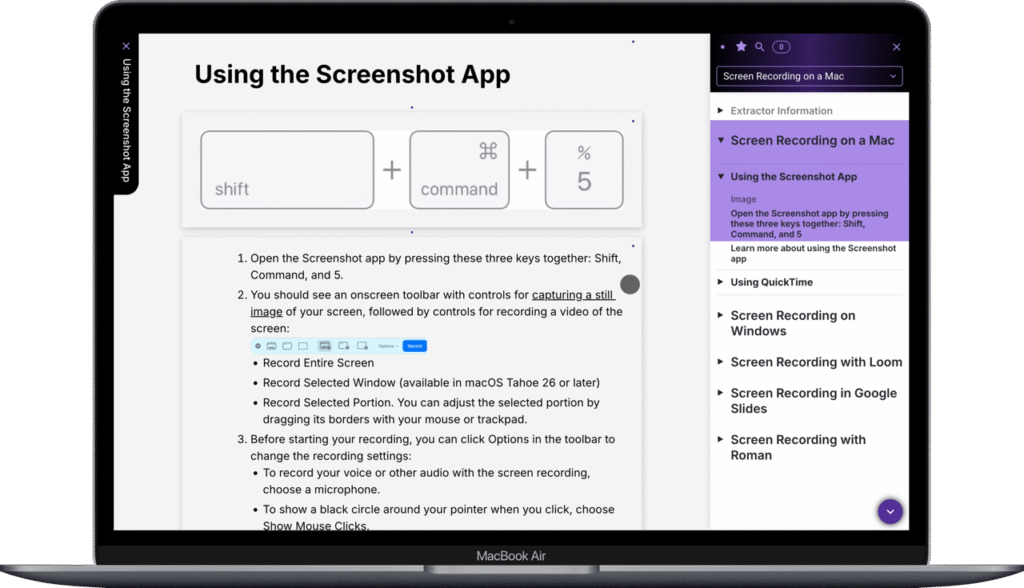
At a high level, our pipeline analyzes the PDF layout, identifies content regions, detects and classifies elements, normalizes the structure, converts it into a structured format that can be published, enriches it with metadata, and stores it where it becomes operational.
The important part isn’t that this works once. The important part is that it becomes repeatable – because repeatability is what turns a one-off conversion into a real content capability. The extractor improves when it is embedded in rules and feedback loops, not when it’s treated like a one-time “service.”
Why magazines are the stress test
If you want to know whether extraction is “demo-good” or “production-good,” you don’t test it on a clean PDF. You test it on magazines.
Magazines are layout-driven by nature: multi-column pages, shifting templates, mixed blocks of text and images, info boxes, advertising, and sometimes multiple languages in the same issue. We digitize magazines for a Swiss customer, and this is exactly why magazines are such a useful benchmark. They expose brittleness immediately – and they reward systems that can handle variability without collapsing.
And that’s where the bottleneck has moved. Speed is no longer the scarce resource. The scarce resource is the definition of “good,” plus the ability to enforce it at scale through rules, edge-case handling, and QA that is strict enough to trust the output but fast enough to keep production moving.
The takeaway is simple: PDF extraction isn’t the problem anymore. The advantage now comes from building a reliable content pipeline – one that turns layout-heavy PDFs into structured, reusable content on demand.