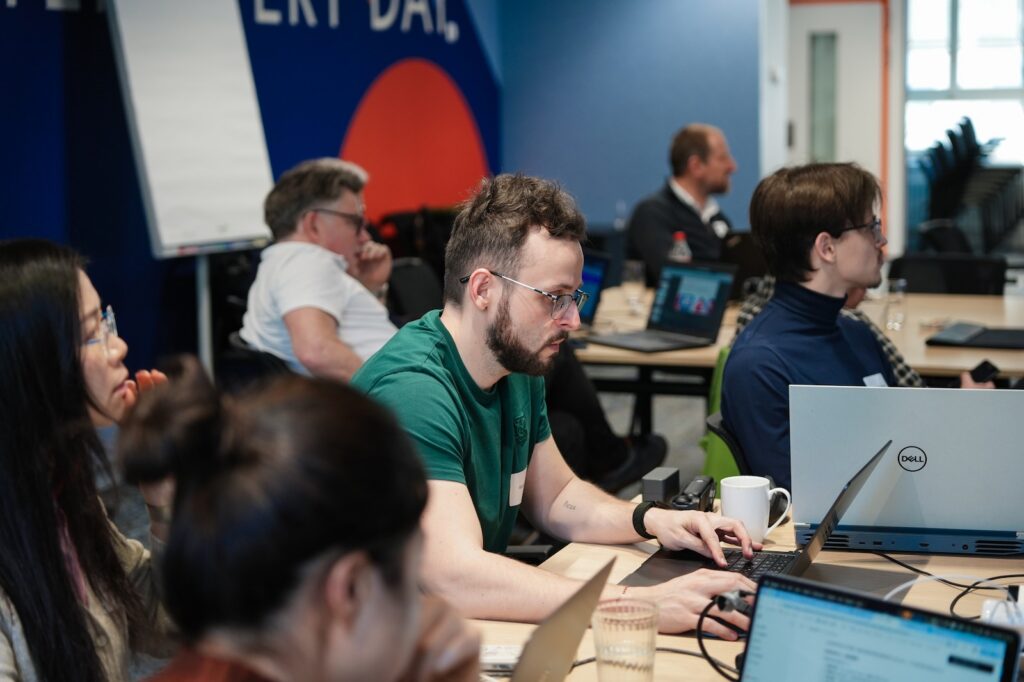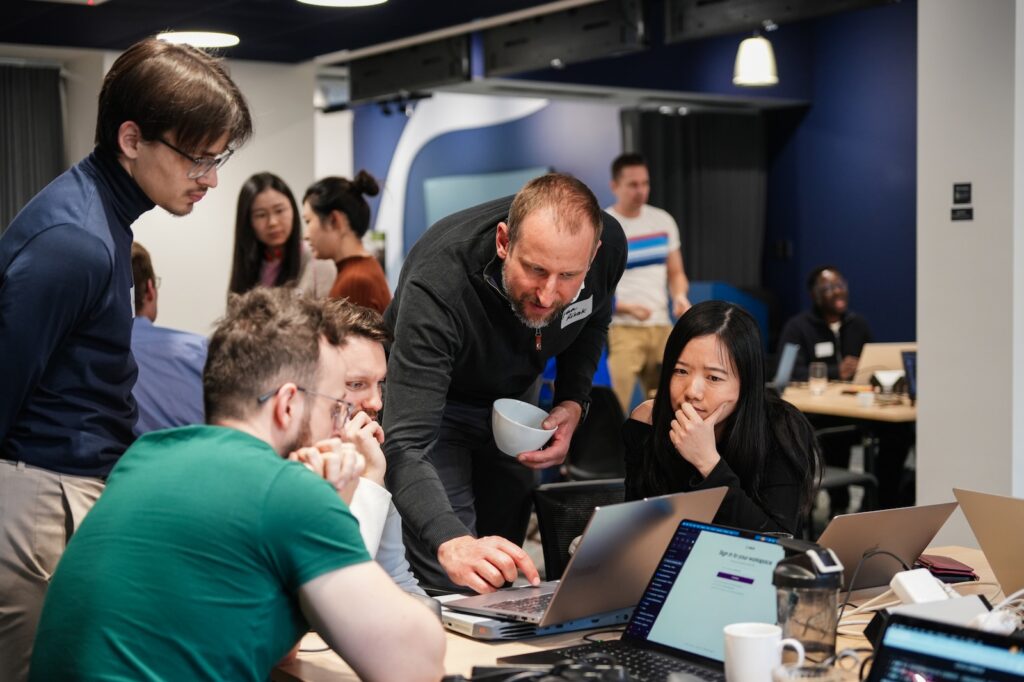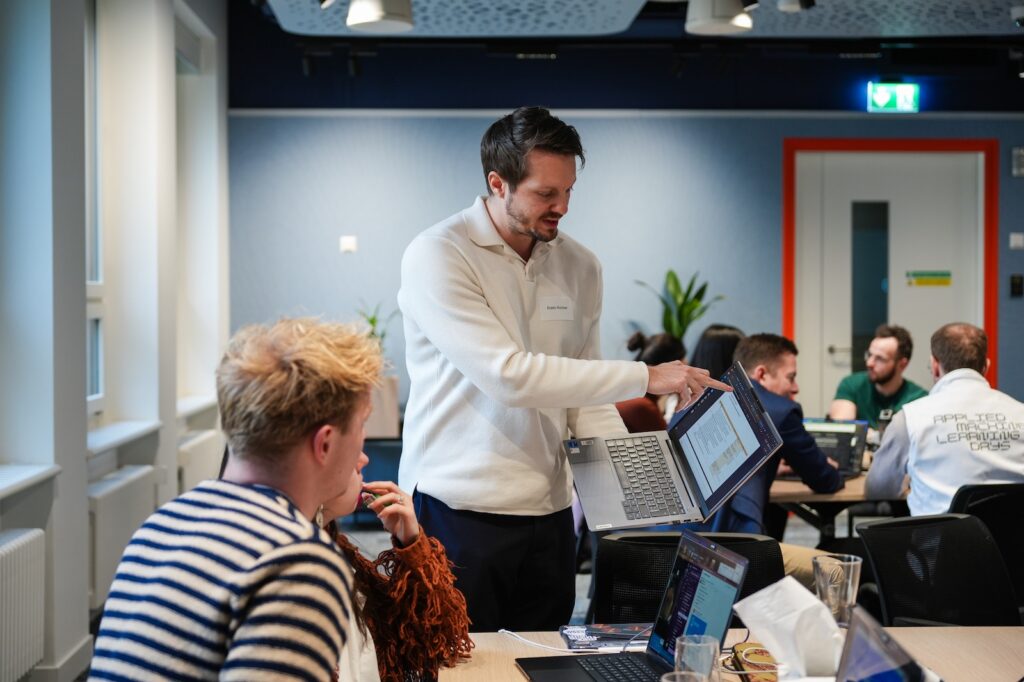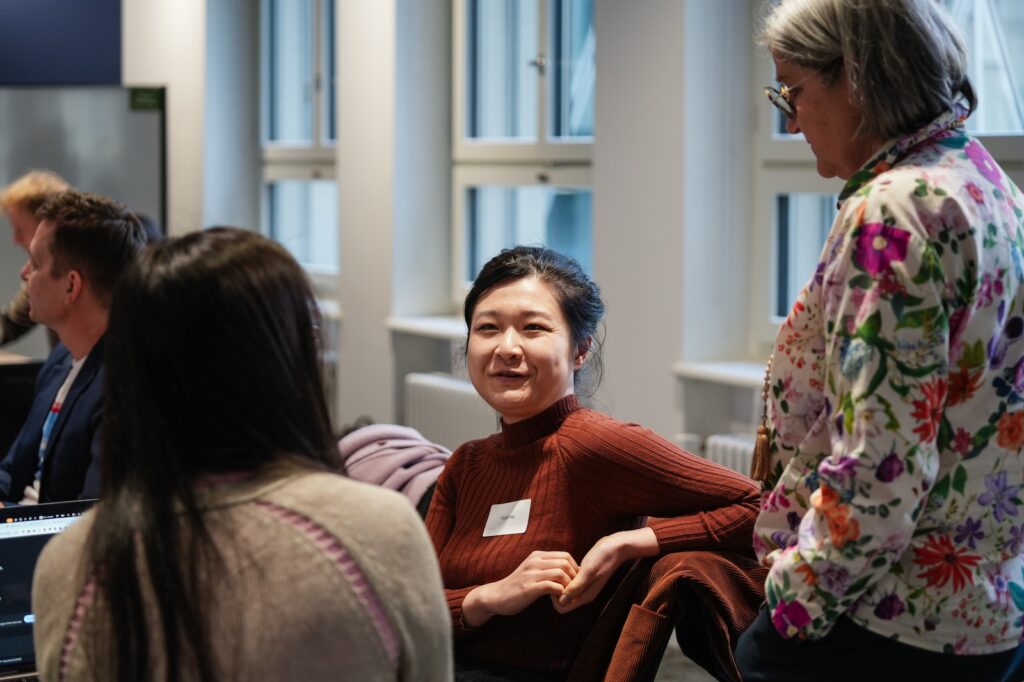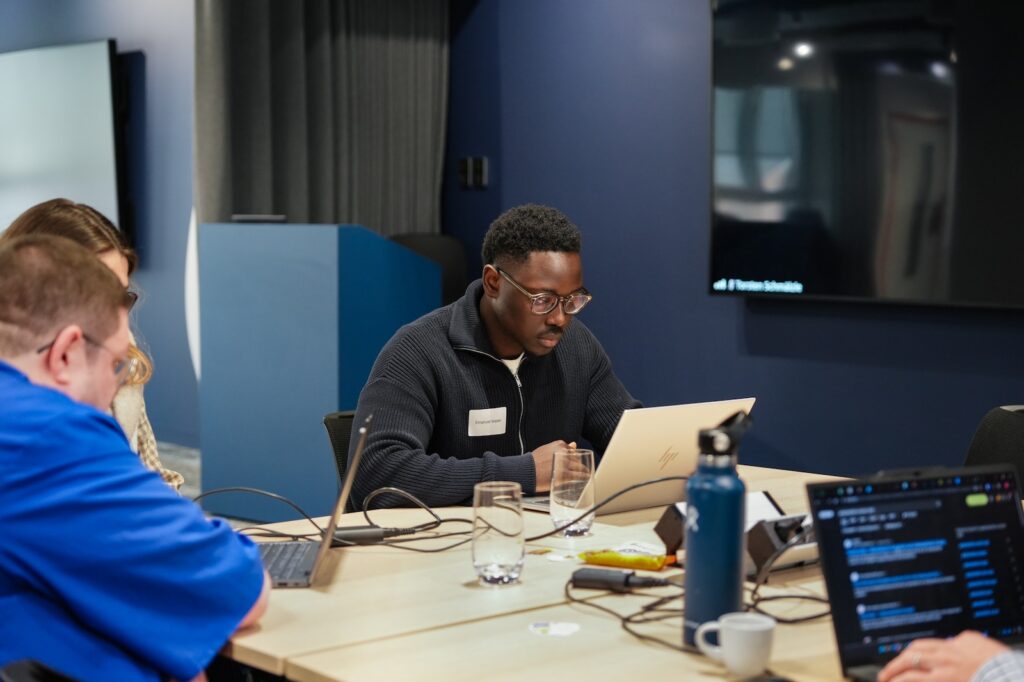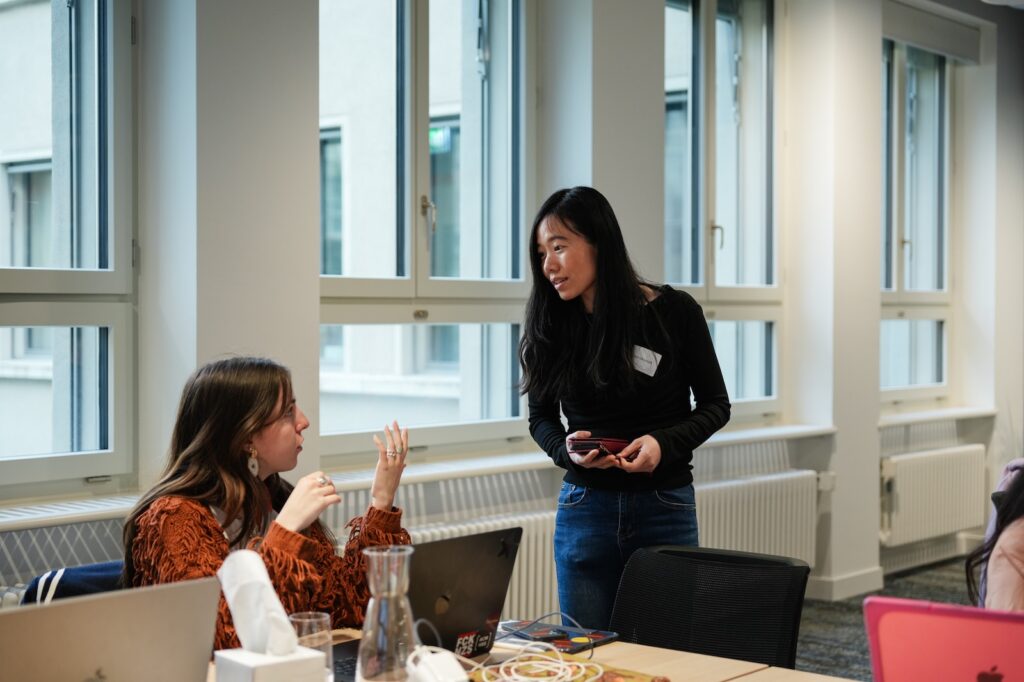

“From Prompt to Product!” – This was the motto when teams from three continents came together for 24 intense hours at the bitmark Hackathon 2026. No sleep for some. Lots of coffee for all. And a clear mission: take the open content standard bitmark, combine it with AI, creativity, and raw energy – and build something real. Fast.
What happened next was pretty remarkable.
Why Hackathons Matter
Hackathons are not just coding marathons. They are concentrated bursts of collaboration – people with different skills, backgrounds, and perspectives coming together to solve real problems under real constraints.
At the bitmark Hackathon, this played out beautifully:
- Rapid prototyping: From idea to working demo in hours, not months.
- Vibe coding: AI tools like Claude and GPT turned even non-coders into builders. Participants described the feeling as “intuitive, fast, flexible” – creative coding without technical barriers.
- Community building: Teams from Ghana, India, Hong Kong, Czech Republic, and Switzerland worked side by side – some on-site in Zurich, some remote, all connected.
- Talent discovery: First-year students pitched alongside seasoned professionals. The playing field was level.
The challenges were set by Edubase, Didaquiz, Classtime, and Reemers – real companies with real content problems. And every single team delivered.

What 7 Teams Built in 24 Hours
1. Edubase Smart Tutor
Problem: Students struggle with prompting AI assistants. Language barriers and isolated chatbots make things worse – the AI is underused.
Solution: An AI tutor embedded directly into e-books. Highlight a paragraph, and the system suggests prompts: explain, extend, translate, or generate a quiz. Powered by a RAG architecture that chunks content into a vector database for precise retrieval.
Why bitmark: Structured, atomic content made retrieval accurate and context-aware – exactly what a smart tutor needs.
2. Big Brain Bridge
Problem: Teachers and knowledge workers with ADHD or similar challenges write chaotically. Current AI tools can’t process unstructured “brain dumps.”
Solution: A denoising engine that strips filler words, extracts key concepts, classifies the desired output (article, quiz, multiple-choice), and generates structured bitmark content. Bonus: a bionic reading mode for focus and accessibility.
Why bitmark: The clear semantic structure of bitmark gave the AI a reliable target format – turning chaos into order.
3. Bitmark Renderer
Problem: Existing learning platforms lack interactive, game-like experiences for younger learners. There’s no real-time feedback loop for teachers.
Solution: An interactive renderer layer that sits on top of bitmark data. Think gamified vocabulary games, multiplayer classroom modes, and instant analytics so teachers can see exactly where students struggle – and intervene on the spot.
Why bitmark: bitmark defines the data, the renderer defines the experience. Swap the renderer, keep the content. That’s interoperability in action.
4. Bitmark Studio
Problem: Creating a structured course from messy sources – PDFs, YouTube videos, Wikipedia articles – is tedious and technical.
Solution: A workbench where you upload any source, chat with an AI assistant to design your course, generate a structured outline, and export bitmark JSON. The user never needs to learn bitmark – it runs invisibly in the background.
Why bitmark: bitmark served as the universal export layer, making courses instantly portable to any platform that supports the standard.
5. Word-to-Bitmark
Problem: Valuable documents are trapped in format silos – PDF, DocX, proprietary systems. Getting them into a usable, structured format is painful.
Solution: A practical pipeline using AI (Claude) combined with standard tools (Calibre, Pandoc, Ghostwriter). The key innovation: an evolving prompt that gets smarter with every document it processes, plus a human QA step for quality.
Why bitmark: As a target format, bitmark offered the right balance of structure and simplicity – richer than Markdown, more accessible than XML.
6. Semantic Structure Extraction
Problem: Documents that look perfectly structured to the human eye are just a chunk of unstructured data for machines.
Solution: A classification pipeline that detects headings, footnotes, lists, and nested structures – then exposes them in an editor where humans can review and correct the AI’s work before export.
Why bitmark: bitmark’s semantic vocabulary gave the classifier clear categories to map to, bridging the gap between visual and machine-readable structure.
7. Classtime Micro-Skills Mapping
Problem: Educational questions lack structured metadata. Without it, there’s no personalization, no reuse, and no adaptive learning.
Solution: A universal micro-skill ID system that maps questions across curricula – Swiss Lehrplan 21, US Common Core, Hong Kong, and Czech standards. Combined with Bloom’s taxonomy and a custom difficulty scoring formula, teachers can now tag, share, and reuse questions at scale.
Why bitmark: bitmark’s structured format made it possible to attach rich metadata to every question – the foundation for truly adaptive learning.
8. Quizzes Please
Problem: Creating quizzes is slow. Taking quizzes is boring. There’s a gap between what’s possible and what’s actually available.
Solution: A gamified platform inspired by the game “Papers Please.” Teachers prompt what quiz they want, the AI generates bitmark-normalized questions, and students play through them with built-in tools like calculators and data tables. Auto-grading included.
Why bitmark: bitmark normalized every quiz into a consistent, portable format – no matter who created it or where it would be used.
Why bitmark Made It All Possible
Eight teams. Eight different problems. One standard that powered every single solution.
Here’s what the hackathon proved about bitmark:
- Atomic content (bits): Every piece of knowledge becomes an independent, reusable unit. No more monolithic documents – just building blocks you can assemble, reassemble, and remix.
- Chunking context for AI: bitmark’s clear structure is ideal for RAG systems. AI models don’t just scan the content – they understand it, because the semantics are built in.
- Controlling APIs to AI: When your content has clear structure and meaning, you control what AI does with it. No guessing, no hallucinating – just precise, context-aware processing.
- Automating workflows: One format powers the entire pipeline – from chaotic brain dump to polished course, from raw PDF to interactive quiz. That’s automation that actually works.
- Making content interoperable: Write once, publish anywhere. No platform lock-in. No reformatting. Your content belongs to you.
- Quick and easy solutions: Every team built something functional in 24 hours. That’s not just impressive – it’s proof that bitmark lowers the barrier to entry for content innovation.
What’s Next
The bitmark Hackathon 2026 was not just an event – it was a preview. A preview of how content will be created, structured, and consumed in a world where AI is everywhere and interoperability is non-negotiable. (some call this “Liquid Content” like described here in this blog)
The open standard is also an open invitation. Whether you’re a publisher, an EdTech company, an L&D professional, or just someone who believes that knowledge should be accessible – bitmark is your foundation.
Curious? Explore the bitmark Association to learn more about the standard. And if you want to see how bitmark powers a complete digital knowledge ecosystem, visit Get More Brain.
See you at the next hackathon. 🚀