
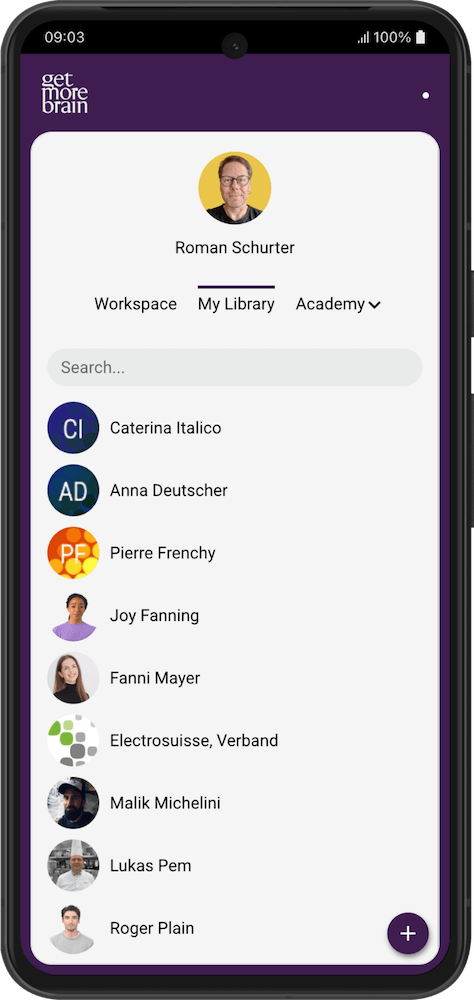
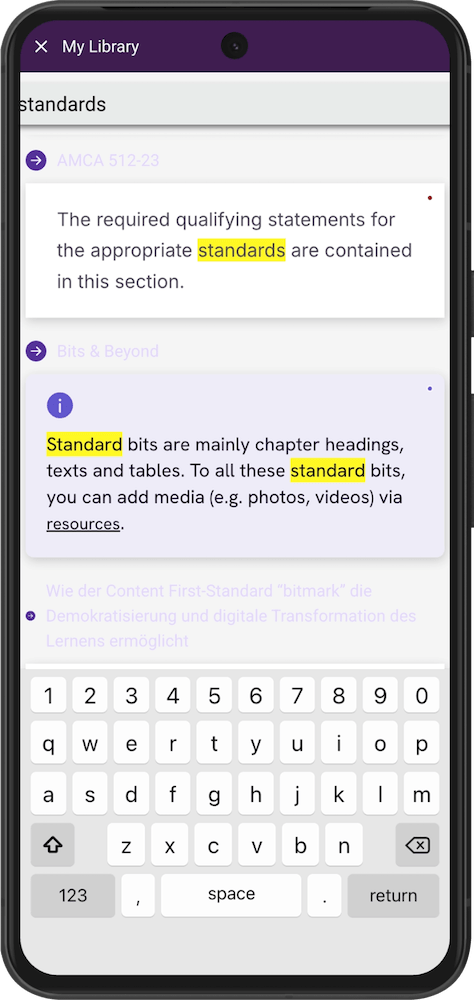
Navigate & Search combines an interactive Table of Contents with powerful search capabilities, making every piece of knowledge instantly accessible – whether you’re exploring a new book or finding that perfect quote from months ago.
Never Lose Track of What Matters
Jump directly to any chapter with our interactive Table of Contents, or use advanced search to find specific content across your entire library. Filter by content type – text, images, videos, quizzes – to locate exactly what you need. Search within a single book or across all your materials at once. Work with search results immediately: send them to colleagues, save to notebooks, or jump to their original context. No more endless scrolling or forgotten insights.
From Information Overload to Instant Clarity
Traditional content systems force you to remember where you saw something or manually flip through hundreds of pages. Our navigation and search features solve this frustration by treating every piece of content as an independently discoverable unit. The interactive TOC provides structural overview while advanced search operators let you combine terms, exclude irrelevant results, and use wildcards for flexible queries. This transforms how quickly you can work: research that took hours now takes minutes. Learning becomes more efficient when you can instantly revisit concepts. Team collaboration accelerates when everyone can find and share the same reference points effortlessly.
Beyond Traditional Books and Search Engines
Unlike static PDFs or physical books where navigation means page numbers and search means indexes, our platform makes every element – every paragraph, image, video, and quiz – independently searchable and accessible. While traditional search engines find documents, we find specific insights within your content universe. Our modular bit-based architecture means you don’t just find content; you can immediately act on it. This represents a fundamental shift from document-centric to knowledge-centric information management, giving you the power of enterprise search combined with the intimacy of personal knowledge organization.